
//INVOLUNTARY MOVEMENTS
//about
//
//Involuntary movements are created throughout the body by the muscles contracting. These are referred to as twitches or myoclonus, though some can create big motions most can go unnoticed. During a restless state the body creates this movement as we slowly lose control of our smaller muscles such as within the lips, eyes and fingers.
Twitches most commonly occur during the sleeping phase- they are known as hypnagogic jerks- this is as we move from consciousness to unconsciousness, as our unconscious brain takes control.
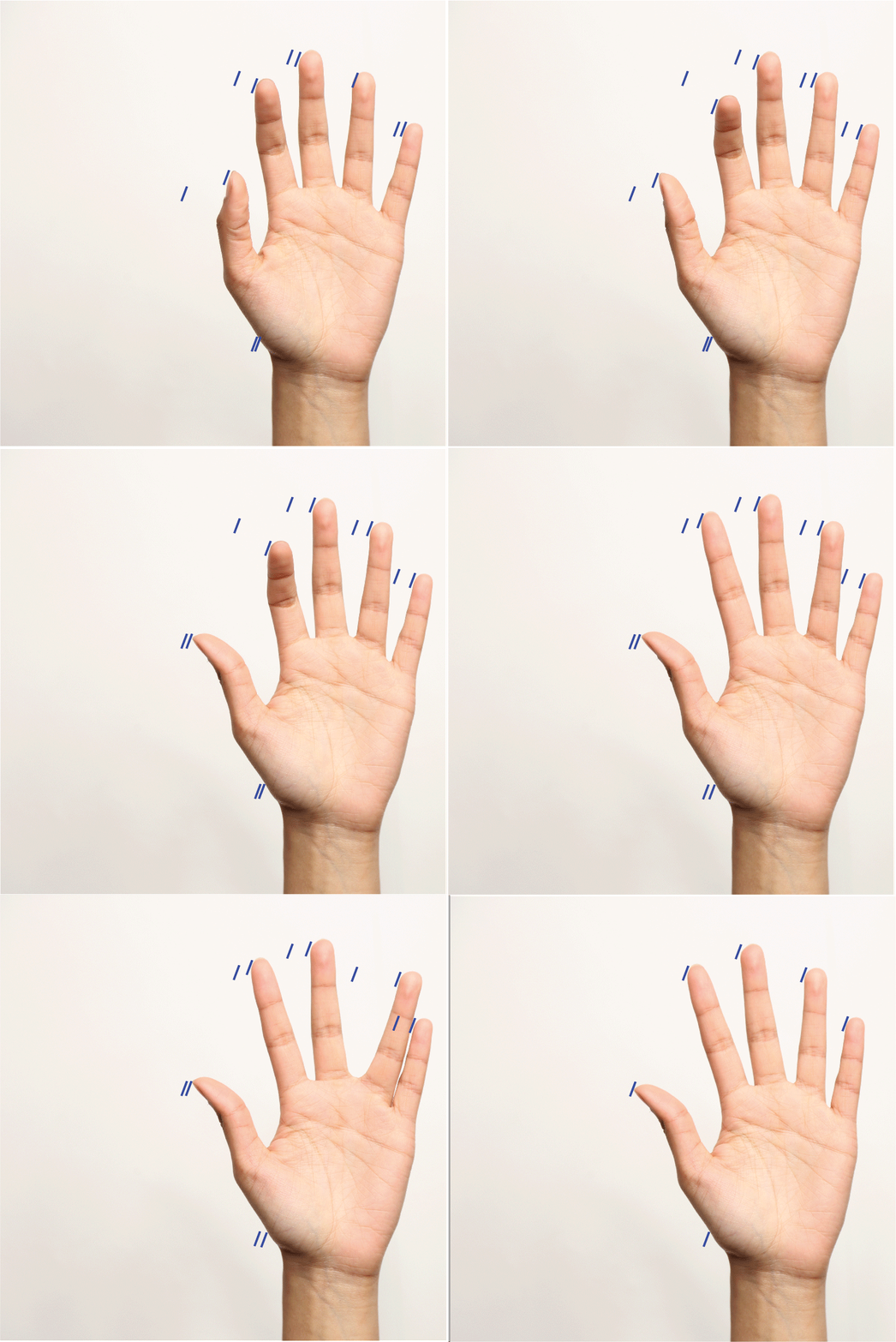
When viewing twitches as frame by frame captures each small movement can be seen. The motion can be created through the viewers own actions but also through the layering of images.
//
//
//
//projects.
//
A record of a stop motion video
//
How a movement can be visually represented and then taken away from the content to act as a visual representation alone.
//
//
//


POSTER FORMAT
Examples, no.9 no.24 no.40
//
 |  |
|---|---|
 |
//
//
//report.
//
//
//
//
//
//

//


//

//



//


//
//
MP Report
Involuntary Movements
//Project Outline
My final project looks into the involuntary movements that are created throughout the body by the muscles contracting, these are referred to as twitches or myoclonus. Though some twitches can be very large and distinguishable motions, the majority go unnoticed. These twitches often occur when the body reaches a rested state and slowly starts to lose control of the smaller muscles such as within the eyes, lips and fingers.
Twitches most commonly occur during the sleeping phase- they are known as hypnagogic jerks- this is as we move from consciousness to unconsciousness as our unconscious brain takes control. Though my initial intention was to focus on sleep, I felt that twitches in general were more interesting as, though we are awake they are things we don't even notice.
//Aims and Objectives
Focusing on the idea of twitches as being unnoticed things, I aim to capture each small movement that occurs to show the transitions by using a stop motion imagery technique. I also intend to focus on how the movement can be created through layering images and also through the viewers own actions.
//Concept Development and Strategy
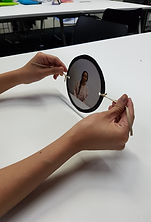
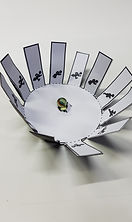
To focus on the idea of the jerking movements that occur and look into a way of creating the movement through an animation technique. I initially thought it'd be a good idea to look into various hand animation techniques, looking into flip books, mechanical flipbooks, zoetropes and thaumatropes. I felt that this would be an interesting way to create a physical piece of work, however also tested out printing images on a multiple level and a larger scale. Because of this I felt that my project should focus more on the aspect of how the movement is created though the viewer.
//Context and Audience
The video outcome produced shows the use of the individual frames in various urban environments, locations where people tend to pass, this is to create more opportunity for the posters to be viewed. My intention is to create interest amongst people who tend to pass by such locations without noticing the surroundings changing, linking to the idea of not noticing something small in our day to day lives.
Through taking part in the project- particularly during the various experiments conducted, which involved placing multiple images in different locations- the hand proved to be an intriguing image. Many people were curious and asked what the message was behind the project, the long line of hands became a talking point. I think during the video shoot the successfulness of generating interest from passers by showed very strongly.
//Visual Development
From discussing the directions that were being taken within my work, the outcomes which focused on taking the small movement of a twitch and making it into something on a larger scale worked well. By producing outcomes to be printed larger and taking the image out of the original sequence successfully broke down the idea of a simple transition, it also worked with my aimed target audience.
I had found it difficult to decide on the best outcome to showcase my aim but found that once I managed to take images of the twitches it was easier to look into an idea. During the process of photography one difficulty that I found was achieving the right level of movement; I found that the twitch needed to be big enough to allow the movement to remain visible when seen as individual images, but also wanted the twitch to appear very directly as though it was natural. Though I initially tried to relax my hand as much as possible to take the pictures I realised that I had to work the images myself to be able to achieve the right level of movement. This was a challenging part of the process.
From my research and experiments into flip books I decided to create a format that focused the framing within a square, aligning the hand to one side, with the purpose of relating to flip books keeping the movement contained to one side. I feel that this worked due to the image themselves, as they were composed in a way that allowed a lot of negative space to be used.
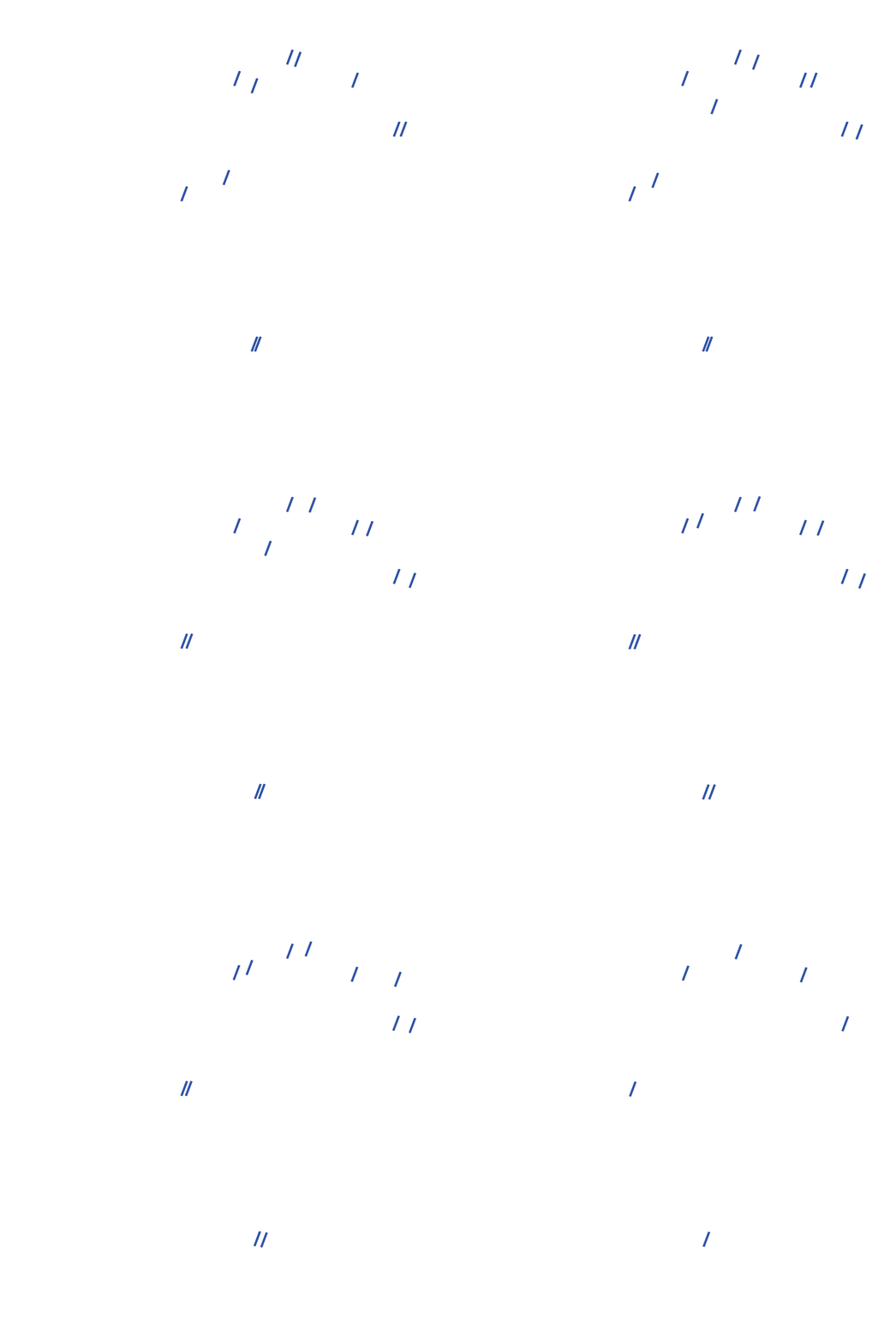
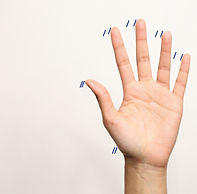
One thing that would be used throughout my various outcome elements, is the visual markers to emphasise the movement, I tested out various versions but found the forward slash to be most successful. i feel like it is a strong line of movement and shows how a movement is carried on. This became an important visual for the project. As the descriptions used throughout the posters and website used the font Avenir I felt it was right to keep consistency and used the same font for the ‘//’.
//Prototyping and Testing
My initial tests involved looking a lot into different hand animation techniques, creating various flip books and zoetropes. Though I found this direction to actually be successful in showing motion, it did not achieve the aim of showing a viewers motion. I then began testing with my photographs, printing to a larger scale frame by frame images and then placing them up next to each other. I tested how a persons speed, such as whilst on a swing could alter what is actually seen. Unfortunately, though it seemed logical in theory, the movement was never quite so easy to capture.
I then decided to test what was seen through a camera, again recording using the same stop motion technique as used previously on the actual images to keep the same consistent idea. Much of my tests focused on using different locations including indoor and outdoor. I found that locations with interesting backgrounds worked well and also using bends and turning points added to the sense of movement. I tested many times using different twitch images and different locations. I also tested the shutter speeds, burst modes and various stabilising techniques, though I initially used bust mode, I decided to go for something more steady and used a tripod to take individual images. This overall was more effective.
//Final Outcome
I looked into creating photographic images to record the movements and the transitions of twitches within a hand, when combined together it successfully shows the motion through the images. I decided to create a typographic visual marker that would aid the images in showing movement. For this I selected the forward slash // as it is used to represent a separation in text, particularly within poetry as it is a tool used to separate a line. As a marker it works well in showing a movement.
I created a video which focused on the stop motion technique again, showing each individual frame displayed along various urban backgrounds. The video is accessible on a website that I created which allows people to find out more about the overall project and the involuntary twitches that go unnoticed.
Another aspect of my outcome included multiple GIFS, these work as a different method of showing movement. I experimented with the markers working alongside the GIFS to emphasise the movement and then created a version that looked specifically at the stand alone markers taking the hand out of context. Though it makes it difficult to see he hand, it still works quite well in showing how a movement actually works as the markers show the indication of movement. These GIFS are also available on the website.
I then created posters using the images with some information on involuntary movements, the idea behind the poster is that it can work as stand alone images to gain interest from passers by, those who see it would be curious about what message it is trying to portray. As I found whilst recording my video it could have been interpreted in many ways such as a political and empowering statement because of the way the hand was use to show symbols. This would then make viewers take notice of the poster. I think the images are strong so can work in having such an affect.
The posters are numbered by the number of frame image they are, this is to show that there are many more moments of movements in between the ones that are there. I believe these posters can work by taking any which number of frame, as an example I tested it as a set of 3: number 9,24 and 40. My intention is to highlight the fact that though there might not be so much change between the image, so much actually happens in-between the number 9 and 23 and within that movement is created. Again I decided to make these accessible on the website.
//I printed these of Tatami white 135gsm
Overall I think that the website works well in tying together the whole project and the different aspects have proved interesting in their own ways. I think the video had some shortcomings as it did not entirely show the movement in the way that I had wished. However I think the locations choices worked and that the actual experience of the recording day was fulfilling as I was able to hear many peoples interest and own thoughts.
//Bibliography
//https://www.youtube.com/watch?v=rm7SlErRs8I
//https://www.ninds.nih.gov/Disorders/Patient-Caregiver-Education/Fact-Sheets/Myoclonus-Fact-Sheet